



Touchscreen Technology Boosts Booth Engagement
Last updated: 12 May 2026
Most trade show booths sit quiet while attendees walk past in seconds, but the ones with touchscreen displays? They’re packed. Booths with interactive screens draw 35% more visitors compared to traditional setups, and that traffic gap keeps widening. If your booth currently relies on printed materials, static banners, or hoping a sales rep catches someone’s eye, you’re leaving serious engagement and lead capture on the table. In this guide, I’ll walk you through exactly how touchscreen technology transforms booth visitor experience, why attendees actively prefer interactive experiences, and how to implement one that actually moves the needle for your business. By the end, you’ll understand why 81% of attendees remember booths with interactive touchscreens, not the ones they walked past.
Key Takeaways
- Booths with interactive touchscreen displays attract 35% more visitors and increase lead capture by up to 35% compared to passive booth designs.
- Interactive displays increase average booth dwell time to 5–12 minutes per visitor, compared to 45 seconds for static displays, giving your sales team a 10–15x longer window to engage leads.
- Touchscreens work because they give visitors control over their exploration, transforming passive observers into active participants without requiring staff availability.
- Modern no-code platforms like POPcomms eliminate the traditional barriers of cost, time, and technical complexity that once made interactive booth experiences expensive and difficult to deploy.
Why Touchscreens Drive Measurable Booth Engagement
Interactive displays boost engagement between visitors and exhibitors by around 50%. This isn’t incremental improvement—it’s a fundamental shift in how attendees interact with your brand. When I began advising marketing teams on booth strategy over two decades ago, the difference between engaged and passive experiences was stark, but the gap has only widened as attendee expectations have evolved.
The core reason is simple: 68% of trade show attendees believe booths featuring innovative technology have limitless potential. Visitors don’t just tolerate technology anymore—they expect it and actively reward brands that deliver hands-on experiences. A booth that invites participation feels forward-thinking, trustworthy, and memorable. A static booth feels outdated by comparison.
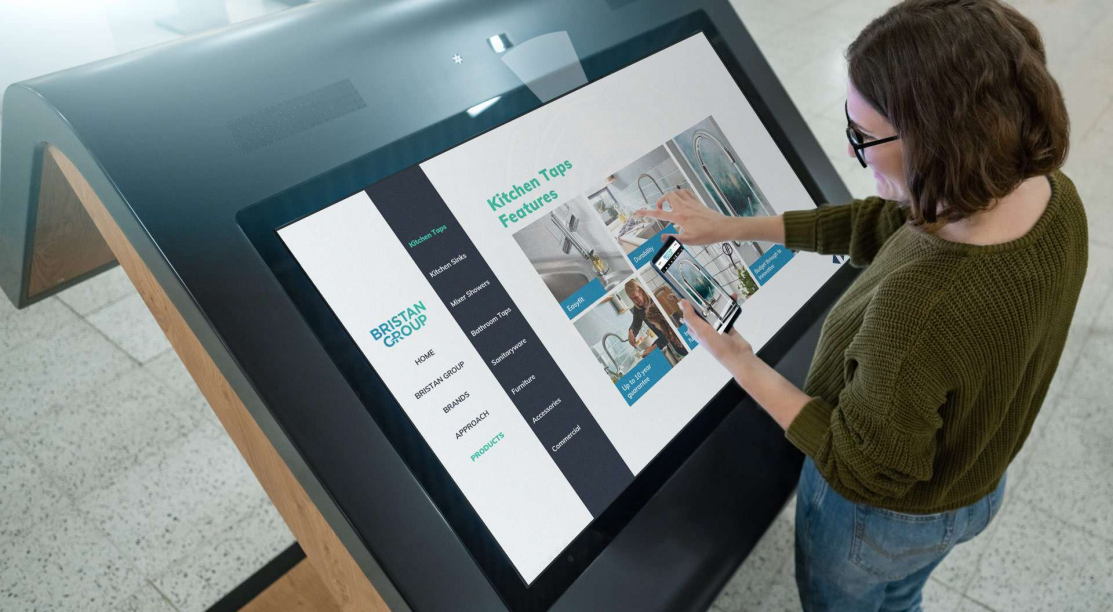
Touchscreen technology specifically gives attendees control over how they explore your brand, making it one of the most effective tools for self-guided engagement. Unlike a brochure, which delivers information at the pace the designer set, or a sales rep, who may not be available when someone shows genuine interest, a touchscreen meets visitors exactly where they are. They decide what to look at, how deep to go, and how long to spend. This autonomy is powerful. It removes friction and transforms passive observers into active leads before your sales team even approaches them.
For teams deploying customized touchscreen interfaces at tradeshows, the visible shift in foot traffic and engagement is immediate. Attendees gravitate toward interactive experiences. They stop, engage, and linger—which is exactly what drives lead quality and volume.
The Psychology Behind Self-Service Interactive Displays
The self-service nature of touchscreens is a big part of why they work so effectively at trade shows. Unlike static banners or brochures, interactive displays invite participation and transform passive observers into active leads. This distinction matters enormously for your bottom line.
Think about how you browse when you’re genuinely interested in something. You don’t want to wait for someone to become available—you want to explore on your own terms, at your own pace, and dive deeper into whatever catches your attention. Attendees feel the same way. When a touchscreen is available, they take control. They browse content, explore products, and drill into detail without interrupting a sales rep or feeling pressured to listen to a pitch before they’re ready.
This self-directed exploration serves multiple purposes at once. First, it qualifies leads naturally. Visitors who spend time drilling into product specs or detailed case studies are already showing genuine interest—your team knows exactly who to prioritize when they approach. Second, it reduces staff load. Your booth team isn’t responsible for explaining basic product information to every passerby; instead, they can focus on deeper conversations with visitors who’ve already educated themselves. Third, it keeps the booth engaging even during quiet periods. A busy booth with staff talking to many people looks attractive and draws more foot traffic. A quiet booth with active touchscreens also looks engaging and attracts visitors—just through different means.
84% of attendees feel more confident about brands that offer hands-on experiences. Confidence is trust. And trust is what converts casual booth visitors into qualified leads and long-term customers. When someone has interacted directly with your products or content on a touchscreen, they’ve moved from passive awareness into active consideration.
Dwell Time, Lead Capture, and the Numbers That Matter
Interactive trade show booths achieve average dwell times of 5 to 12 minutes per visitor, compared to roughly 45 seconds for passive displays—that’s a 10–15x increase in the window your sales team has to start a meaningful conversation.
Let that sink in. The difference between 45 seconds and 5–12 minutes is transformational. In 45 seconds, a visitor glances at a banner, picks up a brochure, and moves on. In 5–12 minutes, they’ve explored multiple product lines, watched a video, downloaded a spec sheet to their email, and had time to genuinely absorb your value proposition. Your sales team has a real opportunity to approach them mid-engagement and have a conversation that actually matters.
This extended dwell time directly translates to higher-quality lead capture. Interactive displays can increase booth dwell time by 30–40% and lead capture by up to 35%. Many of the teams I’ve worked with see even higher numbers when they combine touchscreen engagement with effective touchscreen software with lead capture tools. The data you collect becomes richer too—you know not just that someone visited your booth, but exactly which products they viewed, how long they spent on each section, and what materials they requested. That level of insight is gold for follow-up.
The Freeman Trends Report documents a 3–5x engagement lift from interactive technology overall. But what matters more than the overall figure is what it means for your specific booth. If your current booth attracts 50 visitors per day with an average dwell time of 45 seconds, introducing a touchscreen experience could realistically increase that to 67 visitors with an average dwell time of 5 minutes. That’s not just more people—it’s fundamentally different quality of engagement.
Why Dwell Time Matters More Than Foot Traffic
Many booth managers focus on counting feet through the door. But 30 people who walk past in 45 seconds each are less valuable than 15 people who linger for 10 minutes. Dwell time tells you that genuine interest is building. It tells your sales team when to approach. It gives marketing the data they need to follow up effectively afterward.
Booths that understand this distinction—and design their interactive experiences to maximize meaningful dwell time—consistently outperform those chasing raw foot traffic numbers. The touchscreen isn’t just a tool to attract people; it’s a tool to keep them engaged long enough for your value to register.
Common Objections: Cost, Time, and Technical Barriers
By 2026, the barriers that once made interactive booth experiences expensive and complex have largely disappeared. But I still hear three objections regularly, and they’re worth addressing directly.
Objection 1: “Will This Take a Long Time to Create?”
No. Before specialist software platforms emerged, building a touchscreen experience meant custom programming, which took weeks or months and required a dedicated development team. Today, with no-code platforms like POPcomms, experiences can be created in a fraction of that time. A team member with no coding experience can build and deploy an interactive booth experience in days, not months. You can iterate quickly, test different layouts, and refine based on early feedback. That speed is a huge advantage when you’re approaching a major trade show and need to be ready fast.
Objection 2: “Will This Be Very Expensive?”
Also no. In the past, touchscreen experiences were expensive because they required custom development, specialized staff, and high licensing costs. POPcomms provides a no-code solution that companies can use without the need for a dedicated development team or programmer. You control the costs directly. Smaller teams can build experiences in-house. Larger teams can focus development resources on refinement rather than building from scratch. The investment in the software and hardware is predictable, not open-ended.
Objection 3: “WiFi Is Always Expensive and Unreliable at Events. Will This Work Offline?”
Yes. One of the biggest technical worries for event teams is WiFi dependency. Trade shows have notoriously unreliable internet. But POPcomms is built for trade show touchscreens and can be installed directly on a touchscreen device so it doesn’t require the internet without any loss of functionality. Your experience runs locally, offline, and reliably. You can still send materials to attendees or capture data, but the core experience doesn’t depend on the show’s WiFi infrastructure. That’s a game-changer for peace of mind.
For more details on building a robust offline-capable experience, see our guide on touchscreen software with offline capability.
Building a Touchscreen Booth Experience That Works
Creating an effective touchscreen booth experience isn’t just about installing hardware. It’s about designing an experience that aligns with your booth goals, your audience, and your brand.
Start With Clear Goals
Are you trying to educate visitors about a new product? Generate qualified leads? Demonstrate complex technical features? Gather attendee feedback? Your touchscreen experience should serve that goal directly. A healthcare company might use touchscreens to let visitors explore product features and compliance information at their own pace. An energy sector exhibitor might use interactive displays to show project portfolios or site maps. The format stays the same—the content and user flow should vary based on what you’re trying to achieve.
Explore more about industry-specific implementations in Talk to Our Team