




Last updated: 12 May 2026
Most B2B marketers still rely on static booths and printed collateral, even though the data clearly shows they’re leaving money on the table. Booths with interactive screens draw 35% more visitors compared to traditional setups, and those visitors stay longer, engage deeper, and convert at higher rates. If your team is evaluating B2B touchscreen software solutions, you’re likely facing a familiar frustration: which platform actually delivers what it promises without requiring months of development time or a dedicated technical team? This guide walks you through the core capabilities, cost structures, and decision criteria you need to choose the right B2B touchscreen software solution for your business in 2026, with real examples from companies that have already made the shift.
Key Takeaways
- Booths with interactive touchscreen displays attract 35% more visitors and increase dwell time by 30–40% compared to traditional setups.
- Most B2B attendees now expect innovative technology at trade shows, with 68% believing tech-driven booths have limitless potential.
- No-code touchscreen software platforms eliminate the need for developers and expensive custom programming, reducing both time and cost to launch.
- Offline-capable touchscreen software ensures reliable operation at events where WiFi is expensive, unreliable, or unavailable entirely.
Why B2B Buyers Expect Interactive Touchscreen Experiences
The shift from passive booth design to active engagement isn’t a trend anymore, it’s an expectation. 68% of trade show attendees believe booths featuring innovative technology have limitless potential, signalling that visitors actively expect and reward tech-driven experiences. This expectation cuts across industries, from manufacturing and energy to healthcare and finance.
The reason is simple: touchscreens give attendees control. Unlike a static banner or a brochure, an interactive display lets a visitor browse content, explore products, and drill into detail at their own pace, no need to wait for a sales rep to become available. This self-service model transforms passive observers into active leads. Interactive elements boost engagement between visitors and exhibitors by around 50%, and 81% of attendees remember booths that feature interactive touchscreens. Even more telling, 84% feel more confident about brands that offer hands-on experiences.
The business impact is measurable. Interactive trade show booths achieve average dwell times of 5 to 12 minutes per visitor, compared to roughly 45 seconds for passive displays, a 10–15x increase in the window your sales team has to start a meaningful conversation. That’s not just more visibility, it’s a fundamentally different quality of engagement.
Core Features to Compare in B2B Touchscreen Software
When evaluating B2B touchscreen software solutions, focus on these non-negotiable capabilities:
Ease of Content Creation
The best B2B touchscreen software lets your marketing team build and update experiences without developers. Look for drag-and-drop customization and no-code interfaces that allow rapid iteration. If you need to add a new product video or update pricing three days before the event, your software should support that. The most effective B2B touchscreen software platforms are designed for marketers and sales ops teams, not IT departments.
Multi-Screen Management
Many B2B booths use multiple touchscreens to showcase different products, regions, or departments. Your software must handle 2, 4, or even 8 screens simultaneously while maintaining visual consistency and centralised content control. One company running four touchscreens at a major trade show reported that presenting four unique experiences across departments brought substantial traffic and engagement to their booth.
Rich Media Support
Product demonstrations, customer testimonials, interactive maps, 3D rotations, PDFs, and video content should all integrate seamlessly. One director of marketing noted that the ability to zoom in and show details that can’t be conveyed with a brochure, combined with interactive maps far more engaging than static PDFs, made all the difference in booth performance. Materials should also be sendable directly from the booth to customers for follow-up.
Lead Capture and Data Collection
Integrated lead capture tools allow visitors to submit contact details, preferences, or qualification data directly from the screen. This data should flow immediately into your CRM or follow-up platform, and you must be able to track which materials were sent and opened after the show.
No-Code vs. Custom Development: The Cost and Time Question
Historically, B2B touchscreen software meant custom development. Agencies would spec out your requirements, build a bespoke solution over 3–6 months, and charge tens of thousands of pounds. That approach is still around, but it’s no longer necessary.
No-code touchscreen software platforms eliminate the programming barrier, allowing non-technical teams to deploy interactive experiences in days or weeks instead of months. This shift addresses two critical objections that held many businesses back:
Speed to Launch
With specialist software like POPcomms, experiences can be created and deployed in a fraction of the time they used to take. Your team can design, test, and refine interactive touchscreen content without waiting for a development cycle. One client built an eye-catching digital tool to showcase products with videos and interviews in time for an upcoming show, using a user-friendly interface they could control themselves.
Cost Efficiency
Before no-code solutions, touchscreen experiences usually needed to be programmed by dedicated developers, which was expensive and time-consuming. No-code platforms deliver the same visual polish and interactivity at a fraction of the cost, making B2B touchscreen software accessible to mid-market and smaller organizations. One marketing team reported getting 100% of what they wanted with a no-code platform, versus the typical 60% delivery rate they’d experienced with traditional agencies.
Consult our services to understand how no-code platforms can accelerate your project timeline and reduce total investment.
Offline Capability and Event Reliability
One objection that still comes up: “WiFi is always expensive and unreliable at events. Will this work offline?” The answer is yes, and it matters more than you might think.
Offline-capable touchscreen software is installed directly on the display hardware, allowing full functionality without internet connectivity and without any loss of features. This eliminates dependency on venue WiFi, which is frequently slow, expensive, or overloaded during peak event hours. Your interactive experience runs reliably from the moment attendees arrive until the show closes.
Offline capability also protects you against technical failures. If the WiFi network goes down during a critical sales moment, your booth doesn’t go dark. Visitors continue engaging with your products, watching videos, and submitting leads. Learn more about offline-capable platforms that are specifically designed for event environments.
Lead Capture and Post-Event Analytics
The real value of B2B touchscreen software extends far beyond the booth. What happens after the show matters as much as the experience itself.
Live Lead Tracking
Your software should display real-time analytics on the booth, showing how many leads you’ve captured, which content is resonating, and which materials attendees are requesting. This gives your team visibility into what’s working while the show is still running, so you can adjust booth staff positioning or messaging on the fly.
Post-Event Integration
Captured leads and interaction data should flow automatically into your CRM, email platform, or lead nurturing system. You should know which specific products each visitor explored, what materials they requested, and when they opened those materials after returning to their office. One company using four touchscreens found tracking what materials were sent and opened afterward to be invaluable for follow-up prioritisation.
Content Performance Data
Which videos got watched? How deep did visitors drill into product specs? Did they spend more time on your new offering or your established product? This granular data allows your team to refine messaging, prioritize product focus, and prove ROI to stakeholders.
Real-World Results From B2B Teams Using Touchscreen Software
The data supports what we see in the field. Interactive displays can increase booth dwell time by 30–40% and lead capture by up to 35%. Here’s how real B2B organizations applied these platforms:
Manufacturing and Product Showcase
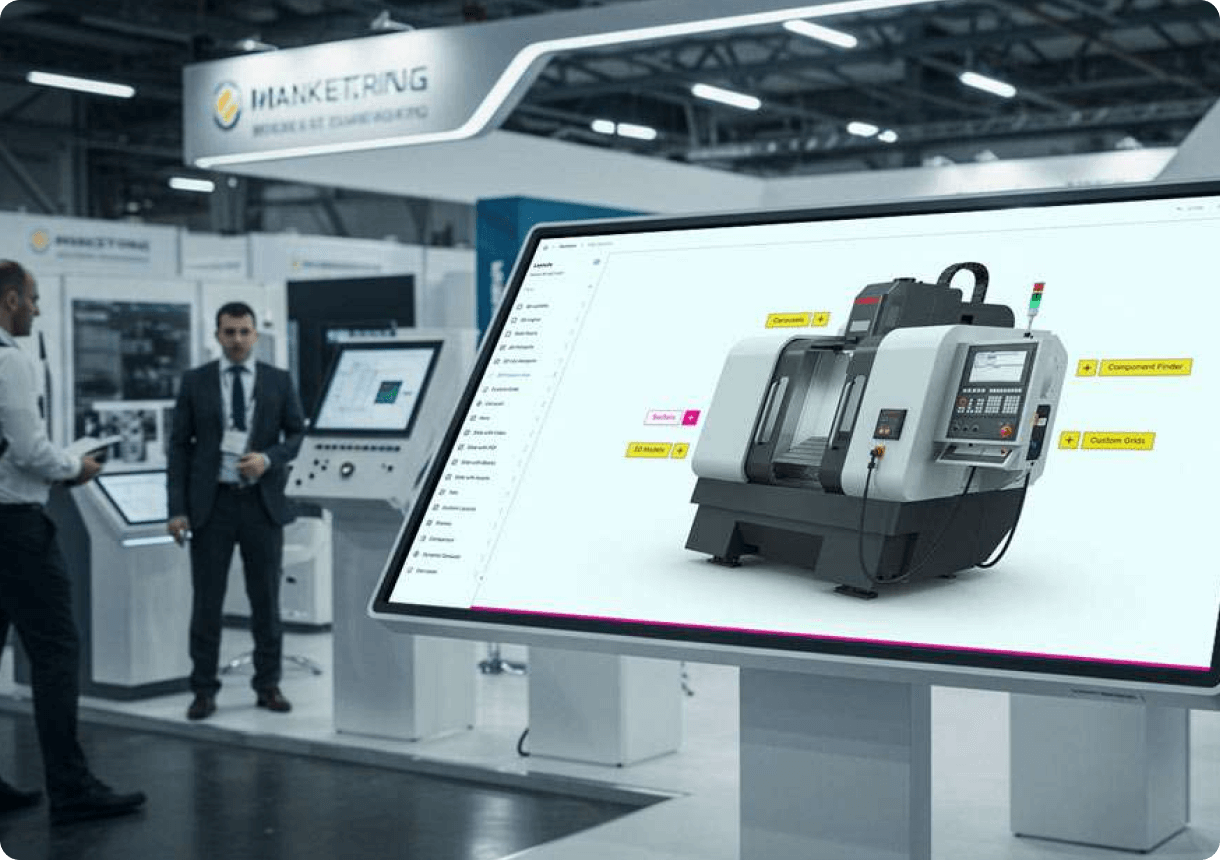
A director of marketing at an industrial equipment company needed a platform that would work offline, include touchscreens, and offer user-friendly navigation. Their team wanted an eye-catching digital tool to showcase products with videos and interviews. Using POPcomms, they created an interactive booth experience that required no coding expertise or specialized training. At the show, visitors simply came up, interacted, and swiped through the content. The lift-and-learn capability, combined with the ability to incorporate videos, PDFs, and live demos, made their booth stand out. Materials could be sent directly from the screen to attendees, enabling immediate follow-up.
Multi-Department Display
A large engineering organization deployed four touchscreens, each presenting a unique experience representing different departments. This approach brought substantial traffic and engagement to their booth. The team could track what materials were sent and opened after the show, providing invaluable data for prioritizing follow-up conversations. The scope of content, from interactive maps to zoomable product details, exceeded what static collateral could achieve.
Simplicity and Team Adoption
Many B2B marketing teams don’t have dedicated tech support. They needed a solution that anyone on the team could pick up and use without coding experience or specialized training. Simplicity and accessibility were absolutely key. Platforms that require minimal onboarding and intuitive interfaces drive adoption, which in turn ensures the investment continues to deliver ROI across multiple events and campaigns.
Ready to evaluate your options? Contact us to discuss how B2B touchscreen software can transform your next event.
Frequently Asked Questions
How much does B2B touchscreen software cost in 2026?
Cost varies based on features and deployment scope. No-code platforms typically range from £500–£3,000 for a single-event license, while custom solutions cost significantly more. Pricing is usually based on number of screens, content complexity, and post-event analytics features. Most providers now offer flexible licensing models that don’t require long-term contracts.
What’s the difference between touchscreen software and digital signage?
Touchscreen software enables visitor interaction, content exploration, and data capture, transforming passive viewers into active leads. Digital signage displays static content without interactivity. For B2B events, touchscreen platforms deliver 3–5x higher engagement lift because they invite participation rather than broadcasting.
Can touchscreen software work without WiFi at trade shows?
Yes. Offline-capable touchscreen software is installed directly on the display device, requiring no internet connection. All features, including video playback, lead capture, and interactive navigation, function identically whether online or offline, eliminating dependency on unreliable venue WiFi.
How long does it take to build a touchscreen experience with no-code software?
With no-code platforms, experienced teams typically create a complete booth experience in 1–4 weeks, depending on content volume and customization. Traditional custom development takes 8–16 weeks. The speed difference enables rapid iteration and last-minute adjustments that wouldn’t be possible with development-dependent solutions.
Which industries benefit most from B2B touchscreen software?
Manufacturing, energy, healthcare, technology, industrial equipment, engineering, and pharmaceutical sectors all report strong ROI from interactive touchscreen booths. Any B2B industry where product complexity, visual demonstration, or lead quality justifies the investment sees measurable lift in visitor engagement, dwell time, and qualified lead capture.
Creating engaging touchscreen experiences without custom development takes the guesswork out of booth ROI.
Take the next step today.
Related Posts
3D Modelling Made Easy | POPcomms
Read
Build Interactive Product Catalogs on Touchscreen
Read
Interactive Display Software for Energy Sector
Read
Floor Standing Touchscreen Booth Software
Read