




Top Touchscreen Software Leaders in 2026
Last updated: 12 May 2026
Trade show booths with interactive screens draw 35% more visitors compared to traditional setups, yet most companies still treat their booth experience like a static billboard. This mismatch between attendee expectations and what’s actually being delivered costs you leads every single day. The good news is that modern touchscreen software has fundamentally changed what’s possible, and the industry leaders in 2026 are delivering experiences that were impossible just five years ago. In this article, you’ll discover which platforms are winning, why they’re winning, and most importantly, how to evaluate them against your specific booth strategy. By the end, you’ll have a clear framework for making a decision that drives real results.
Key Takeaways
- Booths with interactive touchscreen displays increase dwell time by 30-40% and lead capture by up to 35% compared to passive displays.
- 81% of trade show attendees remember booths featuring interactive touchscreens, making them one of the highest-ROI engagement tools available.
- The best touchscreen software platforms in 2026 are no-code, meaning your team can create custom experiences without hiring developers or waiting weeks for deployment.
- Offline functionality is non-negotiable for trade shows and events, because WiFi is unreliable and paid connectivity eats into your booth budget.
Why Touchscreen Software Matters More Than Ever in 2026
The self-service nature of touchscreens is why they work so effectively at events. Unlike static banners or printed brochures, interactive displays invite participation and transform passive observers into active leads. Attendees can browse content, explore products, and drill into detail at their own pace, with no need to wait for a sales representative to become available.
The numbers are compelling. According to EXHIBITOR Magazine research, interactive trade show booths achieve average dwell times of 5 to 12 minutes per visitor, compared to roughly 45 seconds for passive displays. That’s a 10 to 15 times increase in the window your sales team has to start a meaningful conversation. Interactive elements also boost engagement between visitors and exhibitors by around 50%, and beyond that, 84% of attendees feel more confident about brands that offer hands-on experiences.
The expectation has shifted. According to industry research, 68% of trade show attendees believe booths featuring innovative technology have limitless potential, signalling that visitors actively expect and reward tech-driven experiences. Touchscreens in particular give attendees control over how they explore a brand, making them one of the most effective tools for self-guided engagement. This isn’t optional anymore, it’s the baseline for serious event participation.
The Top Touchscreen Software Platforms Today
The touchscreen software market in 2026 includes several strong contenders, each with distinct strengths depending on your use case, budget, and technical capacity. Here are the leaders reshaping event engagement:
POPcomms: No-Code Simplicity Meets Professional Results
POPcomms has emerged as a standout in the touchscreen software space, particularly for teams that need professional results without the development overhead. The platform is built specifically for trade shows, events, and interactive installations, which means it doesn’t force you to adapt a generic software tool to your booth needs. Instead, it’s designed from the ground up for the exact challenges you face: offline operation, fast deployment, and seamless lead capture.
What sets POPcomms apart is its no-code approach. You don’t need a developer on staff or a six-week implementation timeline. Marketing teams, event managers, and booth coordinators can create interactive experiences themselves using drag-and-drop interfaces. As Mark Currier, Director of Marketing and New Business at CLD Inc, USA, noted, “With POPcomms, I got 100% of everything I wanted and more. It’s impressive how exact everything was.” The platform supports video, PDFs, interactive maps, product demos, and integrated lead capture, all without coding.
Another key strength is offline capability. POPcomms is installed directly on the touchscreen hardware, so it operates without WiFi or internet dependency. This means no bandwidth limitations, no connectivity issues mid-event, and no surprise costs for paid WiFi access. For Olga Bryzgalova, Marketing Manager, this was essential: “We wanted a modern, engaging solution for trade shows, something that would work offline, include touchscreens, and offer user-friendly navigation. POPcomms gave us an eye-catching digital tool to showcase our products with videos and interviews.”
The lead capture functionality is particularly strong. You can send materials directly from the booth to attendees, and track what was sent and opened afterward. For GEA, managing multiple touchscreen experiences simultaneously proved invaluable: “With four touchscreens, we could present four unique experiences across departments, which brought a lot of traffic and engagement to our booth. Tracking what materials were sent and opened afterward has been very useful for us.”
Other Notable Platform Categories
While POPcomms focuses on the no-code event space, the broader market includes platforms falling into several categories:
- Enterprise Digital Signage Solutions: Platforms like Samsung Smart Signage and LG SignStudio focus on managing large networks of displays across multiple locations. These are powerful for permanent installations and multi-venue campaigns, but often require IT involvement and ongoing support.
- Custom Development Platforms: Some companies opt for fully bespoke solutions built by development agencies. This offers complete customization but carries high costs, long timelines, and dependency on your developer for updates.
- Low-Code Middleware Solutions: Platforms that sit between your data systems and touchscreen hardware, useful for enterprises but often overkill for events.
For marketing and events teams, POPcomms offers a focused alternative that avoids the bloat and complexity of enterprise platforms while delivering professional results faster.
Key Evaluation Criteria for Choosing a Provider
The most effective way to choose touchscreen software is to align it with your specific use case first, not your budget. Too many teams pick based on price and regret it when they discover they can’t do what they actually need.
Here are the evaluation criteria that matter:
1. Speed to Deployment
How long does it take from signing the contract to your experience live on the booth floor? For trade shows, you often have 4 to 8 weeks. A platform that requires 12 weeks of development is already disqualified. No-code solutions like POPcomms typically deploy in days to weeks. Custom solutions take months.
2. Offline Operation
Does the platform require internet to function? At trade shows and large events, WiFi is expensive, unreliable, or simply not available. If your software is cloud-dependent, you’re vulnerable. Touchscreen software with offline capability is non-negotiable for events because it guarantees performance regardless of connectivity.
3. Ease of Content Creation and Updates
Can your marketing team create and modify content without IT involvement? If you need a developer to change a single product photo or update pricing, you’ve chosen the wrong tool. The best platforms let marketing own the content creation process.
4. Lead Capture and Integration
Does the software collect visitor data, and can it integrate with your CRM, email platform, or lead management system? Touchscreen software with lead capture tools should let you export data in real time and track which materials were accessed and by whom.
5. Support and Training
What happens when something goes wrong at 2 PM on the first day of the show? Do you have access to a support team that understands touchscreen events, or are you troubleshooting with a generic helpline? The best providers offer hands-on support during events.
6. Cost Structure
Is pricing based on per-license, per-event, per-screen, or subscription? For a single trade show with one or two screens, a per-event model makes sense. For ongoing installations across multiple locations, subscription pricing is more efficient. Understand what you’re paying for before committing.
No-Code Solutions: The Game Changer for Marketeers
One of the most significant shifts in the touchscreen software industry has been the rise of no-code platforms. This matters because it democratizes access to professional interactive experiences.
Historically, if you wanted a custom touchscreen experience, you had to hire developers. You waited weeks or months for deployment, paid five to six figures, and hoped they understood your vision. If something needed to change, you went through the development cycle again. This made touchscreen experiences a luxury reserved for large corporations with substantial budgets.
No-code platforms like POPcomms inverted that model. No-code touchscreen software eliminates the need for programming expertise because it provides visual interfaces and templates that non-technical teams can use to build professional experiences. Your marketing team creates the experience directly, on their own timeline, in days instead of months. Updates happen instantly. There’s no dependency on external developers.
This shift has had a real impact on adoption. Companies that previously couldn’t justify the cost and timeline of custom development now run multiple interactive displays across different events. Teams that historically created static posters and printed brochures now deliver engaging, trackable experiences that generate measurable leads.
When evaluating our services, the no-code capability should be high on your list. If a vendor’s platform requires developers or technical expertise, it defeats the purpose of modernizing your event strategy.
Offline Capability and Event Reliability
Let’s address a question that comes up often: “WiFi is always expensive and unreliable at events. Will this work offline?”
Yes, but only if you’ve chosen the right platform. The answer is critical because event WiFi is a known failure point. Venues either don’t provide it at all, charge premium fees per device or per bandwidth tier, or deliver inconsistent connectivity that drops during peak hours.
If your touchscreen software is cloud-based and requires constant internet, you’re accepting unnecessary risk. At the moment your WiFi drops, your booth experience fails. Your attendees see a loading screen. Your lead capture stops working. Your team has to troubleshoot connectivity instead of talking to prospects.
The solution is software that operates locally on the touchscreen device. POPcomms, for example, is installed directly on the hardware, which means it functions identically whether connected to the internet or not. You can push content updates before the event, and everything operates seamlessly on-site. This is why touchscreen software with offline capability has become table stakes for serious event players.
Offline operation also protects your data. Visitor interactions, lead information, and engagement metrics are captured locally and synced to your systems afterward, rather than depending on real-time cloud transmission that might be interrupted or delayed.
Making Your Final Decision
Choosing a touchscreen software platform is ultimately about matching capability to your specific booth strategy and timeline. Here’s a practical framework:
If you’re running a single event in the next 4-8 weeks with a limited budget, choose a platform that prioritizes speed and simplicity. POPcomms fits this profile because you can design and deploy a professional experience quickly, without development overhead. The platform’s no-code interface and offline operation mean you control the timeline.
If you’re building a permanent installation or managing multiple locations, you might have more flexibility on timeline and can afford to evaluate platforms with deeper integration capabilities or more extensive customization options. However, you should still prioritize ease of content updates and staff training over raw feature count.
Before you commit, ask these final questions:
- Can we create and update content without developer support?
- Will this work reliably without internet at our event?
- Can we capture leads and export data in the format we need?
- What’s the actual cost of ownership over 12 months?
- Is there someone we can call when something goes wrong?
If a vendor can’t clearly answer all five, they’re not the right fit. The best platforms in 2026 are transparent about capabilities, realistic about timelines, and focused on your success at the event itself.
For more detailed guidance on how to customize touchscreen interfaces for tradeshows, or if you’re ready to explore what’s possible, we’re here to help.
Frequently Asked Questions
What is the best touchscreen software for trade shows?
The best choice depends on your specific needs, but no-code platforms like POPcomms are leading the market in 2026 because they offer fast deployment, offline operation, lead capture integration, and don’t require developers. For event-specific use cases, purpose-built platforms outperform generic digital signage solutions.
How much does touchscreen software cost?
Pricing ranges from affordable per-event licenses starting around a few hundred pounds for no-code platforms, to five or six figures for fully custom development. Most modern platforms use either per-event, per-screen, or subscription models. POPcomms, for example, removed the expensive custom development barrier by offering scalable, fixed pricing with no coding required.
Can touchscreen software work without WiFi at an event?
Yes, absolutely. Purpose-built event software like POPcomms operates entirely offline because it’s installed on the touchscreen device itself. This eliminates WiFi dependency, removes connectivity risk, and saves you money on expensive event internet packages. Content updates are deployed before the event and function seamlessly without any connection.
How quickly can we deploy touchscreen software for our booth?
No-code platforms can typically go live in days to weeks, while custom development solutions take 8-12 weeks or longer. If your trade show is within 4-8 weeks, a no-code platform is essential. POPcomms customers typically deploy within 2-3 weeks from contract to live experience on the booth floor.
What features should I prioritize in touchscreen software?
Prioritize offline operation, no-code content creation, integrated lead capture, and support during events. Secondary features like video playback, PDF display, and interactive maps matter, but only if the foundation is solid. Choose a platform where your marketing team can update content independently and where everything works reliably without IT involvement.
Evaluating touchscreen software takes time, and your event timeline is ticking. The leading platforms in 2026 have removed the complexity and cost barriers that used to make interactive experiences unrealistic for most teams.
Take the next step today.
Related Posts
Real-Time Data Collection With Touchscreen Kiosks
Read
Install Interactive Touchscreen Display Software
Read
Why Immersive Technology & Brand Storytelling Are A Great Fit
Read
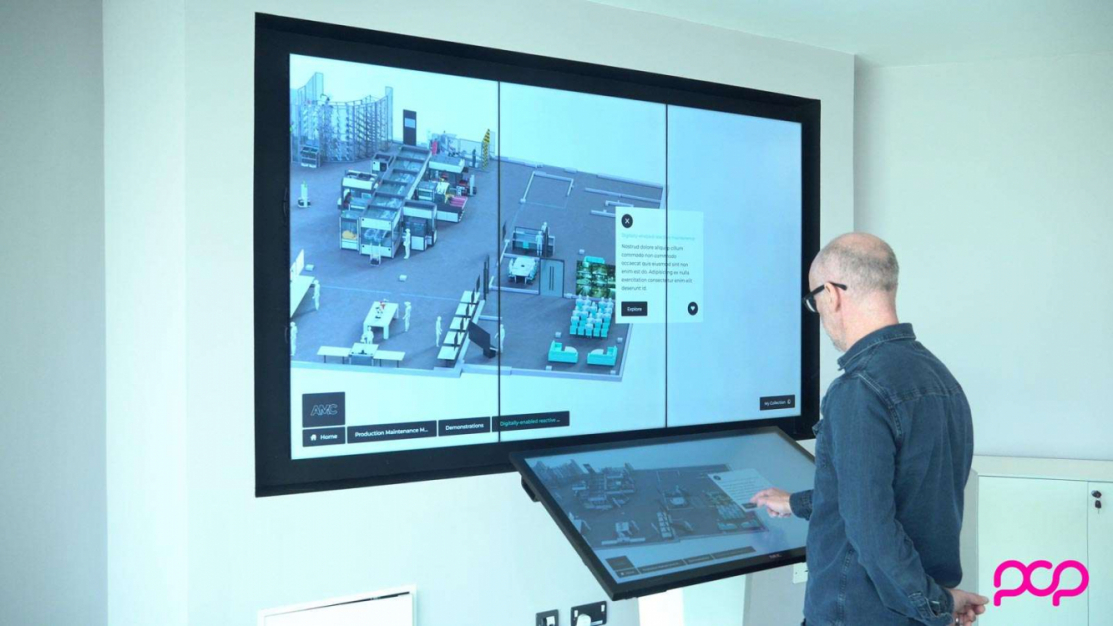
ABB – Digital Manufacturing Ireland customer experience center
Read